
“Did You Know!”
The First Great Black Golfer was Bobby Jones’ Caddy Master!
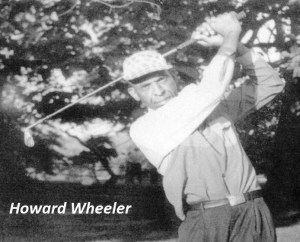
Howard “Butch” Wheeler was born in Atlanta in 1911. He left school after the sixth grade to become a caddy at Atlanta’s Brookhaven Country Club, where he began playing golf. With limited access to left-handed golf clubs Wheeler played golf right-handed with his left hand on the grip below his right hand in an interlocking grip. This was called a cross-handed grip, which at that time was not uncommon for left-handed men. Wheeler was a beanpole, six-foot-two-inches and so slender that one man said, “Wheeler’s back pockets nearly touched”. As a teenage caddy at Brookhaven, Wheeler’s golf game began to blossom. When Bobby Jones would play at Brookhaven, Wheeler was said to be his favorite caddy.
Before the 1960’s, in the USA, access to golf tournaments for Black golfers was nearly nonexistent. To play in a USGA championship one had to be a member of a USGA member club, and those clubs rarely had Black members. The PGA shunned Black golf professionals, and in 1934 inserted a clause in its constitution barring non-Caucasian membership.
Even with limited opportunities Black people learned to play golf, and some were playing well. Looking for a way to compete with other Black golfers an organization called United Golfers Association was formed. Tournaments were played during the year at various locations. The UGA’s first championship was held in 1925. Their championship became known as the Negro National Championship. For some years after World War II; heavyweight boxing champion, Joe Louis, ran a tournament in Detroit.
Before Wheeler there was another Black Atlanta golfer named Robert “Pat” Ball, who had caddied for Jones as well. Ball won two of the first five Negro National Championships, along with two more in later years. By the mid 1920’s he had moved to Chicago and was operating a miniature golf facility in the city. Even though Ball was winning on the NGA Tour, he had not turned pro. In August of 1928, Ball and two other Black golfers were entered the USGA’s Public Links Championship, which was being played at Cobbs Creek Golf Club in Philadelphia. After playing 36 holes, Ball and one of the other Black men had successfully qualified for the match play rounds. They were then disqualified on “made up” violations of the rules during qualifying. A lawyer came to their assistance, obtaining a temporary injunction which prevented the tournament from proceeding. The USGA threatened to move the remaining rounds to New Jersey. Having won their objection and seeing they were not welcome, Ball and the other man simply withdrew. This event was supposed to be the USGA’s championship for amateurs who did not belong to USGA member clubs.
At the age of 20 and playing in his first professional tournament, Wheeler won the UGA’s 1931 Atlanta Open. About that time Wheeler became the caddy master at East Lake Country Club. In 1933 he won the UGA’s Southern Open. In late August, with the financial help of some Atlanta golfers, Wheeler and six other Black golfers left Atlanta for Illinois to play in the NGA Championship. At the same time the World’s Fair was in progress in Chicago. Wheeler won the 72-hole tournament and $100 first prize by three strokes.
Wheeler resigned as the East Lake caddy master to play the UGA circuit. When he wasn’t playing tournaments, he could always return to caddying or part time caddy master employment in Atlanta.
Wheeler met bandleader Eddie Mallory at a UGA tournament, and in the late 1930’s Mallory hired Wheeler as a chauffeur for his wife and entertainer Ethel Waters. That year Wheeler won the UGA championship for a second time, setting a tournament record. One snowy night near Boston, Wheeler was involved in a three-car accident. No one was injured, but Wheeler moved to Los Angeles, where it didn’t snow, and he could play golf every day.
Not long after Wheeler had moved to L.A., Japan bombed Pearl Harbor in late 1941 and the United States was embroiled in World War II. Tournaments on the PGA Tour continued for some months. One was George S. May’s 1942 Tam O’Shanter Open in Chicago. May was a promoter. If daily tickets hadn’t sold, he would send agents into the streets of Chicago to give out free passes. May invited the Black golfers to enter the qualifying round for his tournament and he made Wheeler exempt from qualifying. Earlier in the summer Black golfers had been barred from playing in the Hale America Open, which had been in Chicago.
Wheeler was able to participate, just before reporting to the US Army. In the practice rounds Wheeler drew the largest following, an estimated 2,000 spectators each day. He teed his golf ball on match boxes and hit prodigious drives that carried over 250 yards. Wheeler made the cut with ease, but missed the money as 30 professionals won money.
From July 1942 to July 1946 Wheeler was in the US Army. The US armed services had been desegregated in 1942, but that was not adhered to in many situations like recreation facilities, and especially military golf courses. Most professional athletes were discharged in 1945 as the war was winding down, but Wheeler was in a year longer.
With his US Army commitment nearing its end, Wheeler played in George S. May’s tournament in July 1946, missing the cut. Soon after that he was discharged from Fort Eustis, Virginia with the rank of Corporal. It had been four years without competitive golf and little golf of any kind. In September he won the UGA Championship for a third time.
After leaving the US Army Wheeler moved to Philadelphia. There may have been a lady involved. Richie Harris, a Philadelphia Black golfer and a great golf collector said, when he was young he would babysit Wheeler’s stepdaughter.
Wheeler found a home at Philadelphia owned Cobbs Creek GC, which was open to the public. There was a steady supply of money games with Black and White golfers. In 1947 he won another NGA Championship, this one at Cobbs Creek. He won it again in 1948, for three straight, and then one more in 1958, at the age of 47. That made it six NGA Championships, later equaled by Wheeler’s protégé Charlie Sifford.
The golfers at Cobbs Creek had formed clubs and owned offsite houses. Wheeler joined the Fairview Club. Other clubs were Quaker City, Tioga and Green Ladies. Playing out of the Fairview Club, Wheeler qualified for the 1950 US Open at Merion GC and the 1951 US Open at Oakland Hills near Detroit.
In 1955 and 1956 the PGA Tour was in Philadelphia for the Daily News Opens at Cobbs Creek GC. Wheeler qualified and made the cut both years, but with only 30 money spots he missed the money. Cobbs Creek’s Charlie Sifford showed his capability by finishing tied for eighth in 1956.
If given the opportunity, Wheeler may have been successful on the PGA Tour like Charlie Sifford, who came after him with a similar record. It would have been interesting.
 Trenham Golf History
Pete
<
div> Gre
LikeLike
pete, thank you for another great article. Henry Wetzel
LikeLike
ThanksPT
LikeLike
Thanks a lot Pete. This full bio of Wheeler had the effect of making my memory of him come alive. In particular the description of how very skinny he was (back pockets almost came together) acted to transport me back to the first tee at Cobbs Creek in 1956. If I had only had an Iphone camera! lamar
LikeLike
Glad you saw the article.Pete T
LikeLike