
“Did You Know”
For more than 100 years the golf ball has been a concern!
The first golf, which began in Scotland, was played with wooden balls. Then for 300 years it was played with leather covered balls that were stuffed with goose feathers. A person could only make three or four golf balls a day. That made them quite expensive, so golf was mostly played by persons of means.
In 1846 the gutta percha golf ball, made from Malaysian Sapodilla tree sap, was created. The ball went farther, was more durable and less expensive. If the ball was damaged it could be heated and remolded.
With more golfers and more industry, gutta percha was becoming scarce by the late 1800s. The best golf balls were selling for $3.50 to $4 per dozen.
 Coburn Haskell, a Cleveland businessman, now known as the inventor of the modern golf ball, was visiting the Goodyear Rubber Company in Akron, Ohio in 1898. Seeing some strips of rubber he began winding them around a ball. When dropped on the floor it bounced back up. That gave him an idea. With the assistance of the Goodyear Company, Haskell formed a business manufacturing golf balls. The “Haskell golf ball” revolutionized the golf ball. The Haskell ball went 20 yards farther than the Guttie, making many of the golf courses 500 yards too short and obsolete. The first Haskell ball was somewhat difficult to control. Some named it the “Bounding Billie”. Haskell made several improvements to the original ball, like improving the cover.
Then, Walter Travis won the 1901 USGA Amateur Championship, Laurie Auchterlonie won the 1902 US Open and Sandy Herd won the 1902 Open at Royal Liverpool GC, all playing the Haskell golf ball. Auchterlonie was the first to win the US Open with all four rounds in the 70s. The Haskell ball was now fully accepted.
On September 1, 1918, the USGA announced that it would take whatever steps it considered necessary to limit the golf ball in regard to distance.
In 1908 a dimple pattern for the golf ball was invented. Rather than pimples or bumps, the golf ball had dimples. This improved the aerodynamics and the golf ball traveled another 20 yards farther. For the next 60 plus years every golf ball had the exact same number of dimples with the same shapes. The golf companies concentrated on improving the core along with the golf ball’s other materials.
Two years later, in 1920, the USGA set limits on the size and weight of the golf ball. It could not be greater than 1.62 ounces and not less than 1.62 inches in diameter.
In spite of the standardization of the ball, the manufacturers continued to find ways to make a golf ball go farther. In 1924 the USGA invited some good players like the U.S. Amateur champion Max Marston to test various golf ball designs at Jekyll Island, Georgia. (Jekyll Island was also where secret meetings had been held in 1910 that created the Federal Reserve.)
It took seven years, but the USGA was finally ready with mandatory changes to the golf ball for the beginning of 1931. The new regulations called for a larger and lighter golf ball. The golf ball now had to be at least 1.68 inches in diameter, and no more than 1.55 ounces. That year at the US Open the contestants’ golf balls were measured at the first tee.
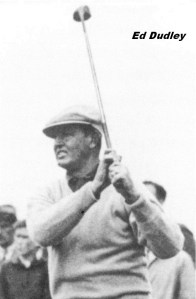 Ed Dudley, in his third year as the professional at the Concord Country Club south of Philadelphia, found the ball to his liking. He won the Los Angeles Open and the Western Open along with compiling the lowest scoring average on the PGA Tour for 1931. Most golfers didn’t like the ball. The lighter ball was difficult to control in the wind. Also at times the light ball would not stay in place on the greens when it was windy. Some frustrated golfers referred to it as the “Balloon Ball”.
On September 15 of that same year, just nine months after putting the ball in play, the USGA pulled the plug on the lighter ball. The 1.68-inch size stayed but the ball could now weigh up to 1.62 ounces. In 2023, those are still the USGA’s required measurements for the golf ball. When Dudley tried out the new ball he said it was so good the golfers would soon be shooting scores in the 50s.
In 1939 the USGA announced that they were working with the manufacturers to stabilize the golf ball at its present length. They said that there were no plans to make any change in the ball, but some kind of safeguard was needed to prevent someone from bringing out a ball that would go 25 or 50 yards farther than the present one.
At the 1940 U.S. Open, the USGA collected golf balls from various contestants. A rumor was going around that a new hot ball was being used by some of the entrants. A spokesman for the USGA said that tests on the balls would be done later in Chicago.
In late June 1941 the USGA announced limitations on the speed of the golf ball. The new regulation would go into effect on January 1. The limit placed on the ball was that its velocity could not be greater than 250 feet per second when measured on the USGA’s driving machine. The USGA stated that it would standardize golf courses by controlling a factor that could distort the whole game.
The Spalding Golf Company came out with a two-piece golf ball in 1968. The ball had a solid core and a synthetic cover made of a DuPont material called Surlyn, which was very durable. You could say golf was back to the Guttie ball of the late 1800s, only much improved. That soon evolved into the Top Flite golf ball. The better golfers still played with wound golf balls, which performed better around the greens.
The next improvement to the golf ball was in the early 1970s. The golf companies began experimenting with new dimple patterns for the golf ball covers. That resulted in golf balls that carried farther, flew straighter, and were less affected by the wind.
In mid March 1976, the USGA announced that new distance standards had been set for the golf ball. The amended rule stated, “A golf ball shall not cover an average distance in carry and roll exceeding 280 yards plus a tolerance of 8 percent”. Testing involved a mechanical golfer on an outdoor range. No golf ball on the market was affected.
In the second week of October, 2000, the PGA Tour was in Las Vegas, Nevada. Titleist had just introduced a new three-piece solid golf ball called the Pro V1. The secret to its success was that the harder it was struck the less it spun, and when it was struck softly, like a pitch shot, it had spin. Thus, it went and it stopped. Earlier in 2000 only 20 percent of the players at that Las Vegas tournament had used solid balls but that week 64 percent of the field played with solid golf balls. The winner was playing the Pro V1 ball. Spalding had had a solid golf ball on the market for 30 years, but now Titleist had perfected it.
In May 2002, the USGA and the R&A issued a joint statement that the golf ball and distance was a problem. Since that joint statement, the average drives on the PGA Tour have increased 20 yards.
In early March 2023, the USGA and the R&A announced at a joint press conference that they were considering implementing a golf ball for elite competitions that would decrease the distance by 15 to 20 yards, perhaps more. The golf ball for recreational play would not be affected. Any change would not take place until 2026.
For more than 100 years golf’s R&D people have been ahead of the R&A and the USGA.
 Trenham Golf History
Pete, Thanks for the golf ball story. Henry Wetzel
LikeLike
I remember in the 1960s watching what was probably the British Open, and players using a ball smaller than the normal US ball. Any thoughts on that? Great article, btw.
LikeLike