
“DID YOU KNOW”
Bob Shave, Jr. taught Sam Snead how to putt croquet style!
In late May 1960 Bob Shave, Jr. left Florida State University after one year of graduate school to give the PGA Tour a try. The next stop on the Tour was the Memphis Open. A 65 in the first round put him in a tie for first. After three rounds Shave was six under par at 204, one stroke out of a first place tie. On Sunday Shave shot a 78, winning $25 for a tie for 35th.
On Tuesday Shave qualified for the US Open in Detroit. He skipped Oklahoma City and headed t Cherry Hills CC in Denver for what is our Open. With one round to play Shave was in a tie for 12th and one stroke ahead of Arnold Palmer. In the final round that afternoon Palmer shot a 65 and won the US Open by two strokes. Shave shot a 77 and tied for 27th. When not at his best, Shave’s chipping and putting were not good enough to save the round.
One year later Shave was back at the Memphis Open. After three rounds he was in a 9-way tie for 22nd. On Sunday he shot a course record tying 63 and tied for fourth. He won $1,700, but the big pay checks were not coming as often as needed. Hauling an Airstream trailer around the USA with a wife and three young daughters added to the challenge.
Bob’s father was a golf professional who was good enough to have played in PGA Champion-ships. Bob, Sr. leased a Donald Ross designed golf course near Cleveland and gave Bob, Jr. a choice. He could work on the golf course at $1 per hour, or hit golf balls at $1 per hour. He hit golf balls by the hour. He won numerous golf tournaments, like the Ohio Open 3 times, but not on the PGA Tour, where he had 21 top ten finishes.
By the end of 1963 Shave knew he needed to change something. He had seen Bob Duden putting croquet style on the PGA Tour. Shave had met Chico Miartuz, an Argentina pro, on the Tour, who had a talent for designing golf clubs. To make ends meet Chico was giving golf lessons at a public golf course in Miami, and making golf clubs at night. Chico had hooked up with a metallurgist who worked as a lifeguard at a Miami hotel pool by day. At night Chico designed golf clubs and the lifeguard created the club heads. The Northwestern Golf Company in Chicago, the largest producer of golf clubs in the USA at that time, sold Chico’s Rake sand wedges and Tomahawk putters.
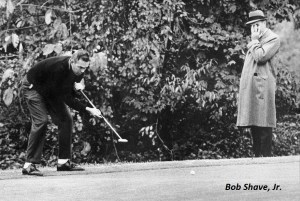
At the suggestion of Shave, Chico designed a croquet style putter for him, which Shave named “The Last Straw”. Shave played the 1964 PGA Tour using his new putter, but did not finish in the top 60 money winners for a full 1965 exemption.
In December of 1964 there was a two-day pro-am at the Boca Raton Hotel & Golf Club, hosted by Sam Snead. A perk for playing was a two-night stay at the posh hotel. After a practice round some of the professionals were hanging around the practice putting green waiting for the dinner hour when Snead appeared. He asked Shave to show him how he putted with his croquet type putter.
Four months later Shave was working at the Philadelphia Country Club giving golf lessons. Nineteen months later, Snead, now 54 years old, was leading the 1966 PGA Championship at Firestone CC at the halfway point. At 139, he was the only player under par. Playing on the lead in the third round Snead missed a 20-inch putt on the 6th green. On the 10th green he double hit his second putt of two feet. The ball found the hole, but with a one stroke penalty for the double hit, his score was five. On the 11th green when Snead putted he bent over holding the putter grip with his left hand and the shaft just above the hosel with his right hand, and rolled his putt toward the hole. Snead must have felt tremors and been practicing with this sometime before. With a near miss that found the pond fronting the 16th green Snead finished with a 75. Byron Nelson, who was standing behind the green, said “One more foot and it would have been a sure birdie.” A 73 in the last round left Snead in a tie for sixth. Al Gieberger finished at even par 280 and won by four strokes.
At the 1967 Masters, Bobby Jones told Snead, “What you’re doing doesn’t look like golf.” Several players on the PGA Tour had been putting croquet style, but now that a big name golfer like Snead was doing it people took notice, especially the USGA.
Later that year the USGA banned croquet style putting as of January 1, 1968. A golfer could no longer straddle the intended line of the putt or even touch the line with either foot.
 Trenham Golf History
Pete, Thanks, I always enjoy your articles
LikeLike