
“Did You Know”
A wild golf shot at the 1939 US Open nearly changed golf history!
The final day of the 1939 US Open was tightly contested. Fourteen players were within five strokes of Sam Snead’s leading 139; a record tying score for the first 36 holes of a US Open. After taking four putts on the 12th hole of the second round Snead had played the next six holes in two under par for a 68. Par was 69.
To disperse the spectators on Saturday, the leaders were not paired together for the final 36 holes of the tournament. Except for gallery ropes around the greens there were no ropes along the fairways to manage the spectators. The players were paired in twos. Snead’s starting times for the day were 9:50 a.m. and 1:50 p.m., giving him plenty of time for a lunch break.
With the starting times at five-minute intervals, Horton Smith, one stroke off the lead at 140, teed off 20 minutes and four pairings before Snead. Byron Nelson, five back at 145, was two pairings before Snead. Craig Wood, two strokes back at 141, teed off 25 minutes after Snead, and Denny Shute, at 142, was out 20 minutes after Wood.
In one of the earlier pairings on Saturday morning, Johnny Bulla took the lead with a 68 for a total of 211 strokes. While the leaders were falling back, Clayton Heafner, playing in the next to last pairing, was putting together a 66. That moved him into a tie for second at 212 with one round to play, along with Snead, Wood and Shute.
In the afternoon Byron Nelson was the first player to post a score that might be a winner when he holed a 12-foot putt for a birdie and a 68 on the last green. That put him in the clubhouse at 284. After just having made a bogey 5 on his 71st hole, Snead stood on the 18th tee thinking he needed a birdie 4 to move into a tie for the lead. With the leaders paired at such random intervals, along with no on-course leaderboards, there was a great deal of uncertainty. Thinking he needed a birdie 4 to tie, Snead made his infamous gamble that turned into an 8, for a total of 286. Later in the day Wood and Shute also finished at 284 to make it a three-way tie with an 18-hole playoff on Sunday.
The playoff was great Philadelphia golf. Nelson was the professional just 50 miles away at the Reading Country Club, and Shute had been the professional at nearby Llanerch Country Club when he won the 1933 British Open. Wood was in his first year as the professional at Winged Foot Golf Club with Henry Poe as his number one assistant. One year later Poe would follow Nelson as the professional at Reading CC and go on to be president of the PGA of America.
The three players were asked if the playoff ended in a tie, did they want to go to a sudden-death playoff or play another 18 holes. They chose to play another 18. With Pennsylvania’s “Blue Laws”, no Sunday sporting event could start until one hour after church services ended. The playoff began at 2 p.m.
The three players arrived at the 18th tee of the playoff with Wood leading Nelson by one stroke. Shute was on his way to posting a 76. From there Wood and Nelson were in the fairway with their tee shots, with Wood 15 yards farther out. Nelson played a 3-wood shot that nearly reached the green. With a heavy left to right wind, Wood tried to cut a 4-wood shot onto the green. Wood’s shot didn’t cut and stayed on the line where it had started. The golf ball struck a spectator and caromed to the right onto the fairway, 40 yards short of the green.
Wood’s golf ball had struck Bob Mossman, a golf professional, in the temple. Mossman was operating a driving range in Ardmore for Ardmore’s renowned club-maker George Izett. Four Pennsylvania state policemen carried the wounded Mossman across the 18th green to an ambulance. Grantland Rice, the dean of American sportswriters, described the scene, “as a trail of crimson on the green.”
After things settled down, Wood’s pitch shot came to rest six feet beyond the flagstick, and Nelson chipped eight feet past. With barely a glance at the line Nelson holed his putt and Wood, who was on nearly the same line, left his putt a few inches short. Now there would be another 18-hole playoff on Monday.
That evening, Wood, one of the great gentlemen of professional golf, visited Mossman at Bryn Mawr Hospital. After some talk about the day’s events, Mossman, laying in his hospital bed but still the eternal teaching pro, said: “Ever since I saw you play for the first time, I knew you should open the face of your driver more. The way you have the club you’ll hook every time. When you play Nelson tomorrow open the face of that club.”
Wood did play golf with his club in a decidedly closed position, but there were others who played that way with great success. Lew Worsham won the 1947 US Open and Claude Harmon won the 1948 Masters playing with the club quite shut at the top of their backswing. Later on, Lee Trevino won nearly everything for twenty years playing with that same club position. Dustin Johnson and Jon Rahm have had success playing with a shut face. Tiger Woods won the 1997 Masters playing with a somewhat shut position and a slightly bowed left wrist. Woods was never better than he was that week when he opened with a 40 on the first nine and then won by 12 strokes.
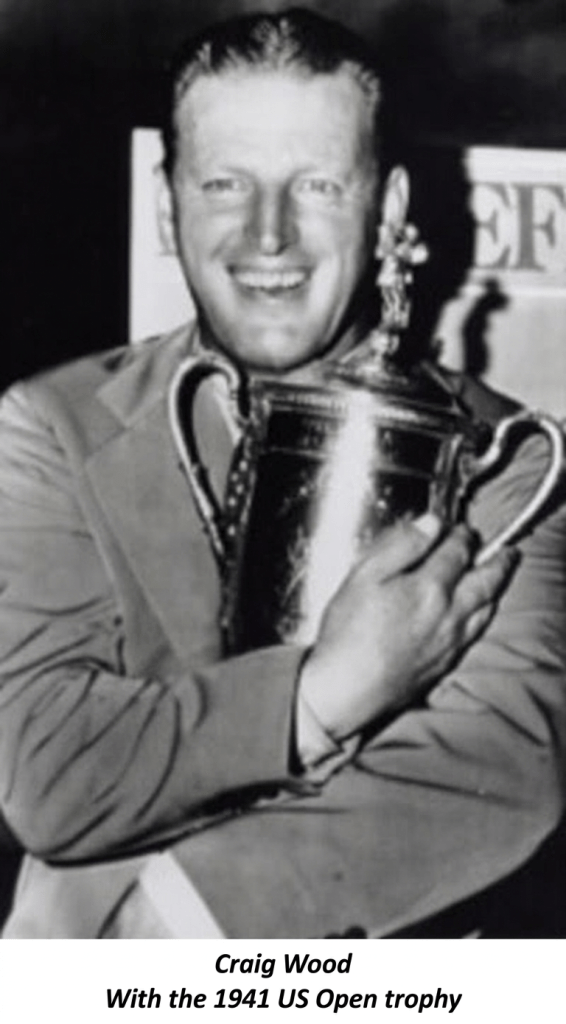
On Monday there was a second 18-hole playoff which Nelson won. Craig Wood was now the holder of the “Grand Slam” of runner-up finishes, and a bit more. Wood had finished second in the Masters twice; 1934 to Horton Smith by one stroke, and again in 1935 to Gene Sarazen in an 18-hole playoff. He lost in extra holes to Paul Runyan in the final round of the 1934 PGA Championship and lost the 1934 British Open to Denny Shute in an 18-hole playoff. When Craig Wood’s golf ball ended up in the fairway after striking Mossman’s temple, he still had a good chance to win. He might have holed his birdie putt and never have been the holder of the “Grand Slam” of runner-up finishes. Also, Nelson would not have won any US Opens.
In 1941 Craig Wood would finally win a major when he won both the US Open and the Masters.

