How Walter Hagen found an exhibition partner!

“Did You Know”
How Walter Hagen found an exhibition partner!

Joe Kirkwood was born in 1897 in Sydney, Australia and was introduced to golf as a caddy. Kirkwood was labeled a truant as he was skipping school for golf, so at the age of ten he was sent to work on a sheep station far from his Sydney home.  The owner of the sheep station was a golfer, so he and Kirkwood set up a three-hole golf course.

While tending the sheep Kirkwood would hit golf balls. At times he would fool around hitting shots that weren’t ordinary, like big hooks and slices or standing on one foot. At age 16, his employer entered him in a golf tournament at a nearby town. Kirkwood won the tournament.  With that his employer arranged for him to serve his five-year apprenticeship as an assistant professional at the Manly Golf Club, back in Sydney.

Australia became involved in World War I and servicemen began returning from the war with injuries like amputated legs. Kirkwood found that he could entertain the hospitalized men with his golf shots and especially his trick shots. When he hit golf balls standing on one leg, he was able to show the wounded men what they might be able to accomplish.

In 1920 Kirkwood won both the Australian and New Zealand Opens. Then some local people gave Kirkwood money to play in the 1921 British Open. In early March of 1921, Kirkwood left Australia for the British Open via the United States. He played his way across the USA on his way to North Carolina for the North and South Open.

At the North and South Open in early April he was paired with Walter Hagen for all four rounds. Kirkwood and Hagen tied for ninth along with former Philadelphia professional Emmett French, winning last money. The sand greens at Pinehurst were a challenge for Kirkwood as that was a first for him.

Having heard about Kirkwood’s ability to perform various golf shots, he was asked to show them off after the tournament. With the upcoming North and South Amateur Championship, there was a large contingent of golfers present. With a gallery of 700, Kirkwood showed his large variety of golf trick shots. At the conclusion of the show, New York Mayor Jimmy Walker passed his hat around for donations. The money collected totaled more than $400. Later that year, first money at the US Open and the PGA Championship was $500. When Hagen got a glimpse of how much money was in the hat he saw an opportunity.

Hagen proposed teaming up for some exhibitions after the British Open. At the British Open in June at St. Andrews they tied for sixth and set sail back across the Atlantic.

In 1921 there were a few important United States tournaments like the US Open, PGA Championship, Western Open, Canadian Open and Shawnee Open, but not too much else. When they weren’t playing in those tournaments, they played exhibitions which added up to 105 one-day 36-hole exhibitions. Each one included Kirkwood’s trick shot show.

They were a perfect pair. Kirkwood enjoyed the parties but did not drink alcoholic beverages. Hagen was known to consume some alcohol at times, even late into the night. On exhibition days, if Hagen was a bit tardy, Kirkwood would entertain the paying customers with his trick shots. And Hagen never hit any practice shots; he just showed up and played. He said he didn’t want to waste any of his good shots. Kirkwood was more the business person keeping track of the funds and the schedule. Kirkwood never tried to show up Hagen on the golf course. He would hit big hooks or slices out over trees that would end in the fairways. Or he would top his second shots which might then roll a couple hundred yards onto the greens. He might play right hand shots with a left-hand club or the opposite.

Kirkwood was back in the States again in 1922 in time for the North and South Open where he tied for third and Hagen finished out of the money. In late June Kirkwood and Hagen were in Scotland for the British Open at St. Andrews again, where Hagen won and Kirkwood tied for 20th. Then they returned to the states for the US Open in July where Hagen finished 5th and Kirkwood tied for 22th. After that they were off on another exhibition tour with Hagen skipping the PGA Championship at Oakmont CC in August, even though he was the defending champion. One of their exhibitions was at Philmont Country Club in front of 5,000 golf fans.

In 1923 Kirkwood returned to the states and joined the PGA of America. There were more exhibitions with Hagen. Later that year, he purchased a home near Philadelphia in Glenside and joined the old Cedarbrook Country Club, a Tillinghast design.

Kirkwood was a great golfer. Along with winning those Australian and New Zealand Opens he also won the North and South Open, Canadian Open and Philadelphia Open. During the 1923 winter tour, Kirkwood won three straight tournaments in Texas, with one being the Texas Open. But golf exhibitions were more lucrative and less stressful than competing against Walter Hagen, Gene Sarazen and Bobby Jones in tournaments. Kirkwood put Australian golf on the map. Each year, the Joe Kirkwood Cup is still awarded to the winner of the Australian PGA Championship.
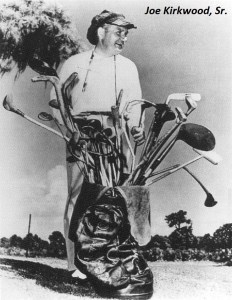
Hagen and Kirkwood took golf around the world playing hundreds and hundreds of exhibitions in North America, Europe, Asia, Africa, Australia and South America. They “grew the game” of golf before the phrase was termed. Kirkwood was golf’s first great trick shot artist. No one did it better.

The “Great Depression” put a damper on business, including golf. Exhibitions were in less demand and Hagen was becoming less into world travel. Kirkwood needed some steady work. In 1938 Kirkwood became a club professional. He took over as the head professional at Huntingdon Valley Country Club, near Philadelphia. He was still able to sell a few of his exhibitions and after WWII there was more money and the interest in his shows was back. He had a line of Joe Kirkwood golf clubs on the market made by Golfcraft. In late 1949 the HVCC board decided to hire a new golf professional. Kirkwood was very popular with the members, and many wished Kirkwood wasn’t leaving. Some days he would hit trick shots from the first tee. Kirkwood had a positive influence on two Huntingdon Valley members who lost in the final of the US Amateur Championship; Duff McCullough and Bill Hyndman. Often he would assist members with their golf games without charging them, but the board said they wanted a professional who would be at the club more often.

At the age of 53 Kirkwood went back on the road with his exhibitions, but without Walter Hagen who was now 57.

The PGA and the touring pros divorced at Whitemarsh Valley CC in 1968!

“Did You Know”
The PGA and the touring pros divorced at Whitemarsh Valley CC in 1968!

With the Great Depression and World War II in the past, the United States was prospering and so was golf. For the first time a golf professional could make a living on the PGA Tour without needing a second job in golf.

In November 1946 Ben Hogan made an unannounced appearance at the PGA’s national meeting in Chicago. At the PGA’s annual meeting any PGA member can present themselves and speak from the floor on any subject during what is called “Open Forum”. Hogan was representing an unofficial group of disgruntled players. For many years the touring pros had been at odds with the PGA of America over prize money, money breakdown, the size of fields, scheduling, field staff, tournament promotion and more. The PGA wanted the leading players to support the PGA Tour by entering more tournaments. The PGA officers agreed to meet with Hogan and the players at the Orlando Open later that month.

After meeting with Hogan and his committee in Orlando, the PGA and Hogan made a joint announcement.  PGA fields would be limited to 150 players. (There had been 210 at Orlando.) The minimum purse on the PGA Tour would be $10,000, up from $7,500 in 1946. The number of tournaments would be reduced from 42 in 1946 to 37 in 1947. The PGA would open an office in Chicago in conjunction with its national office to promote the PGA Tour events. When Hogan was asked about his committee the following week at the Miami Open, Hogan said his committee was dormant.

Then in early April 1950, 25 touring pros threatened to leave the PGA Tour and form their own organization. That included Ben Hogan and all the major tournament winners. There were several evening meetings at the Masters, some lasting three hours. As a result, the players were given the power to elect four players to a committee that included the three officers of the PGA. The committee would represent the players in tournament negotiations, but the officers did have veto power, which they used only once. In 1966 the PGA had vetoed holding a $200,000 Frank Sinatra tournament in Palm Springs because it would have been in the same month as the Bob Hope Desert Classic, also in Palm Springs. 

For years the PGA Tour lost money, but by the late 1960s the television industry was televising more than the majors. Money was finding its way to the PGA Tour. In the third week of August 1968, the PGA Tour was at the Whitemarsh Valley Country Club for the Philadelphia Golf Classic. First played in 1963 its $125,000 purse was the largest in the history of the PGA Tour. Now, five years later in 1968, its $100,000 payout was in the bottom half on the PGA Tour. Some of the big names like Arnold Palmer and Jack Nicklaus did not enter. Only 50 of the 70 players who made the cut earned a check, with last money $100.

The touring pros thought the current $5.8 million in prize money for 1968 should be more, and under their control and management it would be. The PGA officers knew the situation needed their attention. To put out the fire, PGA President Max Elbin arrived on Sunday from Bethesda, Maryland where he was the professional at the Burning Tree Golf Club. Elbin was in the tournament office when the players were filing their entries.

The top 60 from the 1967 money list, along with players from the two Q-Schools were exempt. 30 had earned playing cards in October and another 15 in June. Also, any player who had made the cut the previous week on the tour was in. The tournament sponsor could invite six also. PGA members and amateurs with low handicaps could pay an entry fee and attempt to qualify.

On Monday there was qualifying for the remaining spots in the 150 players starting field at Whitemarsh, with 232 players competing for 40 spots. For those who are interested in speed of play, the players were paired in fours, and they all completed their rounds that day. A playoff to break the ties for the last spots was held on Tuesday morning.

After Wednesday’s pro-am the players gathered in the clubhouse for an open meeting. The 150 players, who would be teeing off the next day, and some who failed to qualify were there. Elbin presented the case for the PGA to the players. The players said they did not want to leave the PGA. That evening they voted to form their own association within the PGA. A name for their organization was announced, American Professional Golfers. The officers were: Gardner Dickinson President, Jack Nicklaus Vice President and Billy Casper Treasurer. The attendees were informed that a lawyer had been hired. The committee announced that all tournament commitments for 1968 would be honored. The players had already begun negotiating for tournaments and television contracts for the next year.

As a result of this, the PGA and the APG both began putting together tournament schedules for 1969. In September the PGA Tour Sponsors Association held a meeting in Houston to talk about their future. Both organizations, the PGA and APG, held eight-round Q-Schools in October. 30 player-cards were given out by the PGA at PGA National Golf Club and 21 were given out at Doral Golf Resort by the APG.

In December Leo Fraser, Atlantic City CC owner and professional, was elected president of the PGA of America. After the election Fraser said he would do everything possible to make peace with the APG.

A settlement with the players was made on December 13. The tour players would be an arm of the PGA called the Tournament Division to be managed by a ten-man Tournament Policy Board. The board would consist of the three PGA officers, four players and three independent directors. The board would make all decisions concerning the PGA Tour. The separation was not totally amicable. The PGA did not name a PGA Player of the Year that year, 1968.   

In 1975 the divorce became complete with the tournament players separating from the PGA, taking the name PGA Tour. The PGA of America kept the Ryder Cup, PGA Championship, Senior PGA Championship and 4-man World Series of Golf. PGA club professionals could still enter Monday qualifying until 1983 when the PGA Tour instituted the “All Exempt Tour”. With that there were 125 fully exempt players on the PGA Tour each year along with 25 more earning PGA Tour status at Q-School. Other players had a limited number of exemptions based on previous years and there were still sponsor’s exemptions.

There was peace, but not total peace. In 1974 the PGA Tour created the Players Championship to compete with the PGA Championship. Then in 1994 they created the Presidents Cup to compete with the Ryder Cup. Players on the Ryder Cup team began demanding compensation. To keep the name PGA and still be PGA members, the PGA Tour players pay dues to the PGA.

The PGA Tour, managed by the players, still has many of the regulations like earlier times under the PGA of America. Full time tour members have to enter a certain number of events each year. There are only three releases each year to play somewhere else like the South African Open or the Australian Open. Nonmembers, like foreign professionals, are limited to five tournaments a year.

In 2024 Scottie Scheffler won $29,228,357 plus a $25 million bonus for winning the Tour Championship. That year the 100th player won $2,930,385. Even with that not all PGA Tour players were content.

Hogan, not Dudley, was the non-playing 1949 Ryder Cup captain!

“Did You Know”
Hogan, not Dudley, was the non-playing 1949 Ryder Cup captain!

After seven years as president of the PGA of America, Ed Dudley stepped down from office at the PGA’s annual meeting in December 1948. The delegates from the 30 PGA Sections made Dudley the captain of the 1949 Ryder Cup team, through a unanimous vote.

1949 was a Ryder Cup year with the match being played in England in September. The members of the team were chosen through a point system covering the two-year cycle between the playing of the Ryder Cup on odd numbered years.

The 1948 PGA Tour season ended with Ben Hogan leading by 215 Ryder Cup points over Lloyd Mangrum, who was in second place for the 1949 team. Hogan had won ten times that year. Six were consecutive wins. Hogan began 1949 piling up more points. He finished tenth at Los Angeles, won the Crosby Pro-am and Long Beach before losing a playoff at Phoenix to Jimmy Demaret.

Two days later Hogan was driving home with his wife to Fort Worth, Texas when their Cadillac collided with a Greyhound bus on a foggy morning in west Texas. Hogan’s wife, Valerie, was not seriously injured, but he could have lost his life. Doctors doubted Hogan would even walk again, let alone return to competitive golf.          

In late May the 1949 PGA Championship was held at the Hermitage Country Club in Richmond, Virginia. It was nearing the end of an opportunity to earn Ryder Cup points. There was always a bit of a rift between some of the touring pros and some of the club professionals. The touring pros wanted larger purses and fewer constraints on where and when they competed. Each year the home professionals could see some of their dues going to operate their PGA Tour, which usually lost money. The PGA officials thought of the PGA Tour as advertising, like window dressing at a store. This PGA Championship was no exception for complaints from the players. Some touring pros mentioned that the golf course was not challenging enough. Jimmy Demaret described the course as, 18 holes that looked like the Pennsylvania Turnpike with trees. But each year the PGA had to find a golf course for its championship that would assist in providing a competitive purse that measured up to the other major championships. When the qualifying rounds were played the scores were not low. Ray Wade Hill, a former assistant to Hogan at Hershey CC, led with a six under par 136.

Ryder Cup captain Ed Dudley was another topic at the PGA Championship. Some touring professionals inferred that the election had been rigged by Dudley.

It was after World War II, with a new contingent of stars on the PGA Tour, who knew Dudley, the president of the PGA, as a politician, not a tournament player like them. But Dudley had been a top-level player. In 1931 Dudley had won the Western Open and the Los Angeles Open, along with having the lowest scoring average on the PGA Tour that year.  As the professional at the Concord Country Club and the Philadelphia Country Club, he had played on three Ryder Cup teams; 1929, 1933 and 1937. In the late 1930s, while serving as the professional at Augusta National GC and The Broadmoor, Dudley had been the tournament chairman on the PGA Tour. As a player Dudley knew if the players weren’t happy with him as their captain he should resign, and he did, staying on as the honorary captain.

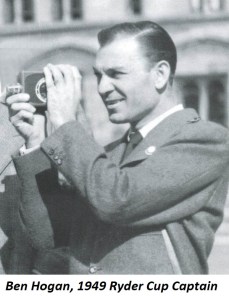
At the conclusion of the Dapper Dan tournament in Pittsburgh on July 18th, the final Ryder Cup points were tabulated, and the team was announced. Even though the injured Hogan had not hit a golf ball since the last day of January he was still in second place in Ryder Cup points, only to Mangrum. At that point, Hogan had been told by his doctor not to swing a golf club for another three months. Hogan said that even though he couldn’t play, he would be traveling with the team to England.  The PGA informed the press that the Ryder Cup team members would be selecting a captain. Soon after that the players named Ben Hogan as their captain, non-playing.  

Before leaving for England the Ryder Cup team played a two-day challenge match near Boston against a team captained by the retired Byron Nelson. With Hogan unable to play golf, the team had only nine members, even though Great Britain & Ireland would have ten. At the conclusion of the challenge match, the New England PGA presented the Ryder Cup team members with a check for $10,500 to help defray the expense of being away from their club jobs and tournament golf for a more than a month.

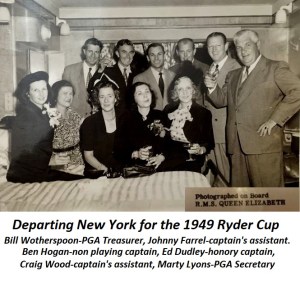
The USA’s Ryder Cup team, PGA officials and wives departed from New York on the Queen Elizabeth on September 3rd, arriving in England on September 10th. The Ryder Cup was being played at Ganton Golf Club in northeast England in the third week of September. That may have seemed like an early arrival, but the Americans had to adjust to playing with the smaller British golf ball that held its line better in the wind. To begin the adjustment, Hogan had his team hitting the British golf balls off the deck of the Queen Elizabeth during the voyage from New York. Hogan said that once on British soil his team would adjust to the smaller golf ball fairly quickly.

When the US Ryder Cup team arrived in England they were greeted by a fleet of Rolls-Royce cars. Each player was driven to the Savoy Hotel by chauffeur, accompanied by a British golf dignitary. Within a few miles it became obvious to Hogan’s host that Hogan was tense. Being driven on the wrong side of the road and not having control of the steering wheel was unnerving to Hogan, so the host had their chauffeur drop back to the tail end of the procession.

The day before the Ryder Cup began Ben Hogan filed a complaint that the grooves on some of the GB&I players’ clubs did not conform to R&A and USGA rules. Renowned golf writer Bernard Darwin, who was a member of the R&A rules committee, was selected to examine the grooves for conformity to the R&A’s rules. He determined that the clubs did not conform. The Ganton GC professional then spent the evening filing away the grooves that were in violation.

The Ryder Cup was one day of four foursome (alternate strokes) matches and one day of eight singles, with one player sitting out each session. GB&I led after day one, three points to one, but the USA came to life the second day winning six of the eight singles matches. Final score: USA 7, GB&I 5.

At the PGA’s annual meeting in late November It was reported that it had cost $25,000 to take the team and PGA officials to England for the Ryder Cup. The delegates were informed that their national dues were being increased from $35 to $45. To help fund their PGA Tour, that was a heavy price to pay for some club professionals who were scraping by at home.

,                                       

Professional golfers used to play without delay!

“Did You Know”
Professional golfers used to play without delay!

There was a time when tournament rounds were played in three to four hours, and even less at times. 

In late July of 1915 the Connecticut Open was played at the Shenecossett Country Club. Play began in the one-day 36-hole tournament at 9 a.m., with the 72 entrants paired in twos. Some of the pairings finished the first 18 holes in less than two hours, with the others were around in 2 hours. Then there was a cut to the low 60. The ones who made the cut were paired in fours for the final 18 holes. With a total of 148 strokes, Whitemarsh Valley Country Club’s Jim Barnes won by five strokes, over Jock Hutchinson and Mike Brady. 

Six years later and four years after having left Whitemarsh, Jim Barnes returned to Philadelphia for the Main Line Open. The tournament was staged by the Philadelphia professionals, who were on the verge of forming the Philadelphia PGA. The tournament was in early November at the Tredyffrin Country Club in Paoli, with 36 holes in one day. Having missed a train connection, Barnes arrived late. He began play on the 10th hole with a professional who had been waiting for him. Playing the first 18-holes in one hour and 45 minutes Barnes shot a course record 72. As some players were completing their 36 holes, Barnes was finishing his first round. After a break for lunch, Barnes played his second round in two hours and ten minutes. Barnes won by five strokes, with a total of 149 strokes for the day.

The 1924 Shawnee Open was held in the middle of July with 36 holes a day for two days. There were 90 entries. At the end of the second day Leo Diegel and Willie Macfarlane were tied for the title. That same day the two professionals played an 18-hole playoff, with Diegel ending up the winner. That was 54 holes of tournament golf in one day.

The 1940 New Orleans Open, played in mid February, had a starting field of 175 players. Even with less daylight at that time of year, the first two rounds were completed each day without problems.

Then in November 1946 there was the Orlando Open at the 6,454-yard Dubsdread Country Club. World War II had ended and the golfers were eager to get back to competing. The golf professionals from the northern states had some down time and the tournament committee took entries right up to the eve of the tournament. On Thanksgiving Day, 210 professionals and amateurs began play at 6:45 a.m., all from the first tee. The committee stated that play began early so the players would not be hurried along too much. Everyone completed their rounds. After round one there was a cut to the low 100 scores.  

In 1950 the US Open was scheduled for Merion Golf Club in Ardmore, Pennsylvania in mid June. A few days before play began, Joe Dey, the executive director of the USGA, announced that excessive slow play would not be tolerated. Dey said that the first three players at the previous year’s US Open at Medinah had taken three hours and 27 minutes to finish their first rounds, and the last three players that day needed four hours and 14 minutes. Dey said that due to that, the field for the 1950 Open had been cut from 171 to 165. Dey threatened two-stroke penalties or even disqualification for offenders.

Now, 75 years later, the 2025 US Open was in Pennsylvania at the Oakmont Country Club with 156 in the field paired in threes. In order to complete play before dark, the USGA started play from the 1st and 10th tees. The first pairing took five hours and 30 minutes, and the last players needed 5 hours and 50 minutes to complete play in the first round.

In 2025 the golf ball goes much farther than 1950. Because of that, the golf courses are longer – 700 yards or more. With that errant drives go farther into trouble. The greens are faster, which take more time to figure out. The USGA rules have become more lenient. Instead of “playing the ball as you find it”, the present rules give the golfers relief from nearly every imperfect situation. The USGA rules have been modified to speed up play, but sometimes they seem to slow down play, with things like tapping down every imperfection in the line of one’s putt. Until 1960 the USGA rules did not allow a golfer to lift and clean his golf ball on the green. Even on the green, if your golf ball was in its own pitch mark you just played it to the best of your ability.

Remember Lloyd Mangrum being penalized for lifting his ball on the 16th green during the 1950 US Open playoff to blow off a bug. A golfer could only lift his ball on the green if it interfered with the play of another golfer.

Five-hour rounds of golf and longer are difficult to watch. Now for entertainment between golf shots, the PGA Tour allows spectators to have their cell phones on the golf course.

Philadelphia was where televised golf found its future!

“Did You Know”
Philadelphia was where televised golf found its future!

While attending the 1956 PGA of America’s annual meeting, Llanerch Country Club professional Marty Lyons sold the delegates on a proposal for his club to host the 1958 PGA Championship.

In July 1957 Lyons and several Llanerch members took a trip to Dayton, Ohio to check out the PGA Championship which was being played at the Miami Valley GC. They were there to learn what they could about hosting a major golf championship.

On returning home, Lyons said he had witnessed the best run championship the PGA had ever held, but it had lost money. The PGA Championship had been played with a match play format for 42 years. Lyons knew there was something missing other than losing money. Lyons decided the tournament would be better if played at stroke play instead of match play.

Lyons wrote a letter to the PGA of America laying out his reasons for changing the PGA Championship to match play. The $42,000 in prize was almost $14,000 more than that year’s US Open but some of the best players did not enter. In five days the finalists had to play four 18-hole matches the first two days and then three 36-hole matches the next three days. That was not appealing to some of the more veteran professionals. With stroke play the starting field would be larger. More PGA members could play in the tournament and the best players in the world would enter. Four days of stroke play would draw more spectators than match play. The tournament would show a profit and more facilities would be bidding to host the championship. Also, with stroke play television companies might be interested, which could make the tournament profitable.

In the fall of 1957 Lyons was in attendance at the PGA’s national meeting in California where he sold the delegates on changing the PGA Championship to stroke play.

Lyon’s work was just beginning. John Facenda, a Llanerch CC member and later the voice of NFL Films, was the nightly news anchor at Philadelphia’s CBS affiliate WCAU. Lyons talked to Facenda about televising the tournament and Facenda spoke to the executives at CBS. A contract to televise the tournament was worked out.

Working on the nightly newscasts at WCAU were two young men who played golf, Frank Chirkinian and Jack Whitaker. Many days they played golf before reporting for work at WCAU. Chirkinian produced the nightly news telecasts and Whitaker reported on sports.

In 1954 NBC had begun televising the last two holes of the US Open for one hour. CBS began televising the Masters In 1956 with six stationary cameras. CBS could not afford to send more to Augusta, Georgia. CBS televised the last four holes for three days. There was one hour of coverage on Sunday and the three days totaled two and one-half hours. Ten million people tuned in over the three days.

With the PGA Championship being a match play format there was no assurance of who would be playing in the tournament final on Sunday, so the television companies had no interest in paying money for broadcast rights.

Even though CBS had been televising the Masters for three years, 32-year-old Frank Chirkinian was chosen to produce the telecast of the PGA Championship. Whitaker did interviews with the leading players for CBS’ nightly news. The last three holes on Saturday and Sunday, along with the awarding of the Wanamaker trophy to the winner, were televised for a total of two and one-half hours over the two days.

1958 PGA Championship

It was great television. Forty-six year-old Sam Snead led with 18 holes to play with Billy Casper one stroke back. On Sunday Snead fell back with a 73. Dow Finsterwald put together a 67 to slip past both Snead and Casper, who was posting an even par 70. Casper finished second and Snead third. That next April Chirkinian was in Augusta, Georgia producing the Masters. For 38 years Chirkinian produced the Masters for CBS. At the same time he directed all of televised sports for CBS. With numerous innovations Chirkinian came to be known as “the father of televised golf”.

Nearly all great Black golfers learned to play golf in the South!

“Did You Know”
Nearly all great Black golfers learned to play golf in the South!

During the early days of golf in the United States there were few opportunities for Black people to play golf. White golfers who had money belonged to clubs that accepted only White people as members. Only the large cities had public golf courses, and the ones in the South were open only to White golfers.

When it came to golf, Black people were mostly caddies. But, even as caddies with limited chances to play, some young Black men began to show promise as golfers. And, it was generally in the southern states.

Wanting to test their golf games against other golfers, Black players began scheduling tournaments, usually on public golf courses in the North where Black golfers were welcome. Before long there were more events with a bit of a schedule. Black golfers decided to form an organization named the United Golfers Association and have a yearly championship.

Their first championship was held at the Shady Rest Golf Club in Westfield, New Jersey on the Fourth of July weekend 1925. Harry Jackson, who was from Washington DC, won the 72-hole tournament with a score of 299, that edged out John Shippen by three strokes. Shippen, a veteran of six United States Opens where he had finished fifth two times, was beyond his best golf at age 45. On Labor Day weekend 1926 Jackson successfully defended his title at the Maple Dale Golf Club in Stow, Massachusetts.  The tournament became known as the Negro National Championship.

Two of the next three UGA Championships, 1927 and 1929, were won by Robert “Pat” Ball, who had grown up caddying at East Lake Country Club in Atlanta. Maple Dale’s host professional, Porter Washington, won the 1928 tournament. The 1930 and 1931 championships were won by Thomas Edison Marshall from Louisiana. Ashville, North Carolina’s John Brooks Dendy won in 1932. Then Howard Wheeler, a tall Black man from Atlanta playing cross-handed, appeared on the scene taking the 1933 title.

In 1934, Pat Ball won the UGA for a third time, and Alabama’s Solomon Hughes won in 1935. Dendy returned to the winner’s circle with victories in 1936 and 1937. The following year, 1938, Howard Wheeler won for a second time.

In 1939 the tournament was in Los Angeles, with California’s Cliff Strickland the winner. Georgia’s Hugh Smith won in 1940 and Pat Ball won his fourth NGA Championship in 1941. With the United States embroiled in World War II and gasoline being rationed, there were no UGA championships or even tournaments from 1942 to 1945.

With the end of WWII, golf was back. Wheeler, who was now living in Philadelphia and playing his golf at the city owned Cobbs Creek Golf Club, won the first three UGA Championships after the war, 1946, 1947 and 1948. Then a new man named Teddy Rhodes, who was heavyweight boxing champion Joe Louis’ golf pro and chauffeur appeared. Louis paid Rhodes’ expenses and entry fees on the UGA Tour. Rhodes, who had as smooth a golf swing as anyone on any pro tour and dressed better, won the next three UGA Championships, 1949 to 1951. Along with that, at one point Rhodes won six straight tournaments on the UGA Tour.

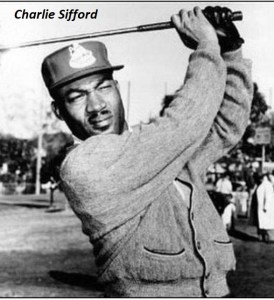
Next it was Charlie Sifford, who had moved to Philadelphia and become Wheeler’s protégé, and by 1952 had taken over the NGA tour. Sifford won the UGA Championship for five straight years, 1952 to 1956. Rhodes grabbed a fourth NGA in 1957 and Wheeler a sixth on in 1958. Someone new to the winner’s circle, a school teacher from Baltimore named Dick Thomas, won in 1959. The next year Sifford won the 1960 UGA to tie Wheeler with six victories. Pete Brown took over in 1961, winning the UGA that year and the next year. And then it was Lee Elder who dominated, winning four NGA’s in five years from 1962 to 1967.

With the assistance of California Attorney General Stanley Mosk, Charlie Sifford had broken through the PGA of America’s “Caucasian Only” clause for PGA membership in late 1961. Black golfers could now become PGA members and try to qualify for PGA Tour tournaments.

Following Sifford and Brown on the PGA Tour with success were; Lee Elder, Calvin Peete, Jim Thorpe and Jim Dent. Elder was born in Dallas and then honed his golf game on the golf course at Fort Lewis, Washington. Elder won four times on the PGA Tour, and then won eight times on the PGA Senior Tour. Peete was picking beans on South Florida truck farms and selling jewelry out of trunk of his car when he began playing golf. Peete won twelve times on the PGA Tour and played on two Ryder Cup teams. Jim Thorpe was introduced to golf as a caddy in Roxboro, North Carolina. The son of a greenkeeper, he won four PGA Tour tournaments and 13 times on the PGA Senior Tour. Jim Dent grew up caddying at Augusta National Golf Club and Augusta Country Club. Dent won twelve times on the PGA Senior Tour.

Except for a professional from Massachusetts and one from Californian, every winner of the 40 UGA Championships began playing golf in a state south of the Mason-Dixon Line. Before they moved to Philadelphia, Wheeler played his early golf as a caddy in Atlanta at East Lake Country Club, and Sifford as a caddy at Carolina Country Club in Charlotte, North Carolina. Rhodes was a caddy at Nashville’s Belle Meade Country Club, and Pete Brown, who also won twice on the PGA Tour, was from Jackson, Mississippi.

It had to be more than a coincidence that most of the Black golfers who had success in tournament golf began playing golf in the South. It may have been because the well-to-do White people had second homes in the mountains or at the beaches, the golf courses were more available to the caddies during the summer months. Maybe the caddies could play more than Monday mornings. Maybe it was the “Great Depression” with many out of work and others working hard to survive that left golf courses open for caddy golf. Or, maybe being restricted from playing golf, made the young Black men even more determined to play the game.   


Blog at WordPress.com.

Up ↑