
“Did You Know”
The 1929 PGA Championship was moved to a new venue at nearly the last minute!
At the 1928 PGA of America’s national meeting the La Cumbre Country Club in Santa Barbara, California was awarded the 1929 PGA Championship. La Cumbre CC member, Ben F. Kerr, had done the heavy lifting to get the tournament awarded to his club.
The tournament was scheduled for December so it would be one of ten PGA Tour tournaments played on the West Coast beginning on November 15, 1929, and ending on January 17, 1930. The PGA required the tournament to have total prize money of $10,000 like the year before at Baltimore. On the day of the PGA’s announcement of La Cumbre CC hosting the tournament, Kerr stated that he had $10,000 already promised through subscriptions and was looking for $5,000 more. This would be $5,000 more than the early January Los Angeles Open.
It was the “Roaring Twenties” but by early summer of 1929 an economic recession had begun. There was huge speculation in the stock market. It seemed like everyone was investing in the stock market. People who had bought stocks on margin were losing money and owed money on their margin loans. Then in August the Federal Reserve raised the discount rate from 5 to 6 percent.
In late August $15,000 was still the number for the PGA prize money being mentioned in the newspapers. But with the PGA Championship only a few months away Kerr was having a problem collecting the promised subscription money for the PGA purse, much less raising the extra $5,000 he had been promising.
Then in September La Cumbre CC announced that it would not be hosting the PGA Championship. It seems that the Club did not want to be associated with something that was going to be a huge failure and a black mark on the Club’s history. With less than the promised and mandatory prize money and no host facility stepping up, one California newspaper referred to the PGA Championship as a “waif tournament”.
Leo Diegel, the holder of the PGA Championship title, had been trying to raise the funds to keep Ben Kerr’s dream of hosting the PGA Championship at La Cumbre alive, but had struck out. It appeared that Diegel wasn’t going to have an opportunity to defend his PGA title.
Then in early October Diegel sold movie mogul Joseph Schenck, who had been taking golf lessons from him on guaranteeing the $10,000 prize money. Along with that, Hillcrest Country Club in Los Angeles, where Schenck was a member, would host the tournament. One hundred of Schenck’s associates agreed to each purchase twenty full week $5 spectator tickets for the tournament. The stock market crashed on October 29, 1929, but Schenck and his associates didn’t back out.
It was the first time the PGA Championship had been played on the West Coast. The PGA reimbursed each of the contestants with the price of a one-way train ticket from his hometown to Los Angeles.
Ed Dudley, George B. Smith and Dave Cuthbert were there from the Philadelphia PGA. Clarence Hackney was missing. Joe Kirkwood, an alternate from Philadelphia, who was on the West Coast performing his trick shot exhibitions, was there to fill in. Kirkwood was the only one from Philadelphia to qualify for the match play but then lost to the medalist in the first round. All matches were 36 holes. For a second straight year Diegel won the tournament and its $1,000 top prize.
It was a sign that finances were becoming difficult when to defend his title, the defending champion of the PGA Championship had to raise the prize money and find a host club.
The PGA had more than a PGA Championship money problem, the Wanamaker Trophy had gone missing. Diegel was presented with a new PGA Championship Trophy at the awards ceremony. Why was there a new trophy and where was the Wanamaker Trophy?
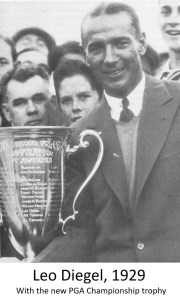 Walter Hagen had won the PGA Championship in 1925 and for the next three years he had continued to win the tournament but hadn’t had the Wanamaker Trophy with him. Where the trophy was had not been a problem as long as Hagen was winning the championship. At the 1928 PGA Championship in Baltimore Diegel ended Hagen’s reign by defeating him in the quarterfinals. Now Hagen had to admit he didn’t have the trophy with him or know where it was. Diegel won the championship. At the awards ceremony, with only a few people in the know, Diegel was presented with a substitute trophy.
In late 1930, Hagen came across the lost Wanamaker Trophy in one of his trunks. Now the PGA had a new problem. It had two PGA Championship trophies, both inscribed with all the winners since 1916. The solution was to polish off all the engraved names on the new trophy and use it to honor the medalist at the 36-hole qualifying for the match play ladder at the PGA Championship.
The PGA’s stroke play trophy became the Alex Smith Trophy. A revered PGA member, Smith had died earlier in 1930. Smith had won two US Opens along with many other important tournaments and been a great promoter of the golf professionals forming a national organization. The Alex Smith Trophy was in play until 1958, when the PGA Championship was changed to stroke play and there was no longer qualifying for a match play ladder.
Four years later in October 1933, Leo Diegel signed on to be the professional at the Philmont Country Club near Philadelphia.
 Trenham Golf History
Leave a comment