
“Did You Know”
Hogan, not Dudley, was the non-playing 1949 Ryder Cup captain!
After seven years as president of the PGA of America, Ed Dudley stepped down from office at the PGA’s annual meeting in December 1948. The delegates from the 30 PGA Sections made Dudley the captain of the 1949 Ryder Cup team, through a unanimous vote.
1949 was a Ryder Cup year with the match being played in England in September. The members of the team were chosen through a point system covering the two-year cycle between the playing of the Ryder Cup on odd numbered years.
The 1948 PGA Tour season ended with Ben Hogan leading by 215 Ryder Cup points over Lloyd Mangrum, who was in second place for the 1949 team. Hogan had won ten times that year. Six were consecutive wins. Hogan began 1949 piling up more points. He finished tenth at Los Angeles, won the Crosby Pro-am and Long Beach before losing a playoff at Phoenix to Jimmy Demaret.
Two days later Hogan was driving home with his wife to Fort Worth, Texas when their Cadillac collided with a Greyhound bus on a foggy morning in west Texas. Hogan’s wife, Valerie, was not seriously injured, but he could have lost his life. Doctors doubted Hogan would even walk again, let alone return to competitive golf.
In late May the 1949 PGA Championship was held at the Hermitage Country Club in Richmond, Virginia. It was nearing the end of an opportunity to earn Ryder Cup points. There was always a bit of a rift between some of the touring pros and some of the club professionals. The touring pros wanted larger purses and fewer constraints on where and when they competed. Each year the home professionals could see some of their dues going to operate their PGA Tour, which usually lost money. The PGA officials thought of the PGA Tour as advertising, like window dressing at a store. This PGA Championship was no exception for complaints from the players. Some touring pros mentioned that the golf course was not challenging enough. Jimmy Demaret described the course as, 18 holes that looked like the Pennsylvania Turnpike with trees. But each year the PGA had to find a golf course for its championship that would assist in providing a competitive purse that measured up to the other major championships. When the qualifying rounds were played the scores were not low. Ray Wade Hill, a former assistant to Hogan at Hershey CC, led with a six under par 136.
Ryder Cup captain Ed Dudley was another topic at the PGA Championship. Some touring professionals inferred that the election had been rigged by Dudley.
It was after World War II, with a new contingent of stars on the PGA Tour, who knew Dudley, the president of the PGA, as a politician, not a tournament player like them. But Dudley had been a top-level player. In 1931 Dudley had won the Western Open and the Los Angeles Open, along with having the lowest scoring average on the PGA Tour that year. As the professional at the Concord Country Club and the Philadelphia Country Club, he had played on three Ryder Cup teams; 1929, 1933 and 1937. In the late 1930s, while serving as the professional at Augusta National GC and The Broadmoor, Dudley had been the tournament chairman on the PGA Tour. As a player Dudley knew if the players weren’t happy with him as their captain he should resign, and he did, staying on as the honorary captain.
At the conclusion of the Dapper Dan tournament in Pittsburgh on July 18th, the final Ryder Cup points were tabulated, and the team was announced. Even though the injured Hogan had not hit a golf ball since the last day of January he was still in second place in Ryder Cup points, only to Mangrum. At that point, Hogan had been told by his doctor not to swing a golf club for another three months. Hogan said that even though he couldn’t play, he would be traveling with the team to England. The PGA informed the press that the Ryder Cup team members would be selecting a captain. Soon after that the players named Ben Hogan as their captain, non-playing.
Before leaving for England the Ryder Cup team played a two-day challenge match near Boston against a team captained by the retired Byron Nelson. With Hogan unable to play golf, the team had only nine members, even though Great Britain & Ireland would have ten. At the conclusion of the challenge match, the New England PGA presented the Ryder Cup team members with a check for $10,500 to help defray the expense of being away from their club jobs and tournament golf for a more than a month.
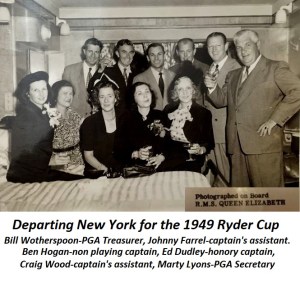
The USA’s Ryder Cup team, PGA officials and wives departed from New York on the Queen Elizabeth on September 3rd, arriving in England on September 10th. The Ryder Cup was being played at Ganton Golf Club in northeast England in the third week of September. That may have seemed like an early arrival, but the Americans had to adjust to playing with the smaller British golf ball that held its line better in the wind. To begin the adjustment, Hogan had his team hitting the British golf balls off the deck of the Queen Elizabeth during the voyage from New York. Hogan said that once on British soil his team would adjust to the smaller golf ball fairly quickly.
When the US Ryder Cup team arrived in England they were greeted by a fleet of Rolls-Royce cars. Each player was driven to the Savoy Hotel by chauffeur, accompanied by a British golf dignitary. Within a few miles it became obvious to Hogan’s host that Hogan was tense. Being driven on the wrong side of the road and not having control of the steering wheel was unnerving to Hogan, so the host had their chauffeur drop back to the tail end of the procession.
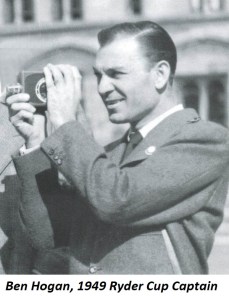
The day before the Ryder Cup began Ben Hogan filed a complaint that the grooves on some of the GB&I players’ clubs did not conform to R&A and USGA rules. Renowned golf writer Bernard Darwin, who was a member of the R&A rules committee, was selected to examine the grooves for conformity to the R&A’s rules. He determined that the clubs did not conform. The Ganton GC professional then spent the evening filing away the grooves that were in violation.
The Ryder Cup was one day of four foursome (alternate strokes) matches and one day of eight singles, with one player sitting out each session. GB&I led after day one, three points to one, but the USA came to life the second day winning six of the eight singles matches. Final score: USA 7, GB&I 5.
At the PGA’s annual meeting in late November It was reported that it had cost $25,000 to take the team and PGA officials to England for the Ryder Cup. The delegates were informed that their national dues were being increased from $35 to $45. To help fund their PGA Tour, that was a heavy price to pay for some club professionals who were scraping by at home.
,
 Trenham Golf History
Leave a comment