
“DID YOU KNOW”
In 1944 the Philadelphia Inquirer had money!
The newspaper put up the second largest purse on the PGA Tour!
With the country at war there had been only four tournaments on the PGA Tour in 1943, but PGA President Ed Dudley had paid a visit to Washington DC. In Washington he had met with the chairman of the War Manpower Commission, who gave his approval for wartime golf. That meant professional golfers could purchase gas for travel to tournaments.
In 1944 the PGA Tour was back with twenty-three events. One was the $17,500 Philadelphia Inquirer Open. That prize money was only exceeded by the Tam O’Shanter Open’s $30,000 purse. There were two tournaments that year with purses as low as $5,000.
The tournament, held at Torresdale-Frankford Country Club in the second week of June, was managed by the Philadelphia Inquirer Charities Inc., with the proceeds going to the newspaper’s charities. Admission was $1.50 on weekdays and $2 on the weekend.
D-Day, June 6, was the Tuesday of tournament week. US military troops were invading the beaches at Normandy. In deference, all scheduled competitions, like long drive, putting and par three contest, were moved to Wednesday.
On Wednesday there was a Pro-Am along with a side exhibition. Byron Nelson and amateur Eddie Lowery took on Philadelphia Country Club professional Jug McSpaden and amateur Woody Platt. Lowery was that young boy who had caddied for Francis Quimet thirty-one years before, when Quimet won the 1913 US Open. Lowery went on to win the 1927 Massachusetts Amateur. Platt was the holder of the Golf Association of Philadelphia Amateur Championship, since he had won it in 1942 and none had been played since. Along with that there was a driving contest. Mal Galletta, recent winner of the North and South Amateur at Pinehurst, won with a drive of 247 yards. Craig Wood, winner of the 1942 US Open and still the holder of the title, was second at 238 yards. Two thousand golf fans showed up to see the golf that day.
With little tournament golf in 1943 and a large purse, golfers showed up from everywhere. Golf professionals, serving in the military like Jimmy Demaret-US Navy, E.J. Dutch Harrison-US Army, George Fazio-US Navy, Lew Worsham-US Navy, Vic Ghezzi-US Navy and Henry Ransom-US Marines had negotiated furloughs. Amateur Skee Riegel, a Philadelphian, was entered out of Miami where he had just completed Emery Riddle University’s flight school.
Most of the Philadelphia area club professionals were working in defense plants, but many found a way to be playing in the tournament. Nelson was classified 4-F by his Draft Board due to his blood being slow to clot. McSpaden was 4-F due to severe sinus problems. McSpaden had been rejected once, but in February 1944 the Philadelphia Draft Board summoned him from the PGA Tour, where he was winning money every week. He must have appeared to be a healthy person. After two days of tests he was classified 4-F for a second time. During the war years Nelson and McSpaden played more than 100 exhibitions for wartime charities.
One hundred thirty-eight professionals and amateurs teed off in the first round of the tournament on Thursday. With the first group of three teeing off at 10 a.m. and all players teeing off from the first tee, there didn’t seem to be any problems with slow play. At the end of 36 holes, Sam Byrd (66-67) led Craig Wood by three strokes at nine under par 133.
On Saturday there were continuous cloud bursts. Some players fared better than others. Byrd posted a 69. With one round to play Byrd led by 7 strokes. It might have been closer. Wood got caught in one of the worst storms of the day, finishing bogey, double bogey, bogey, for 73. In Friday’s round, on the 13th hole, Byrd’s drive hit the O.B. fence and stayed in bounds. Then on the same hole his downhill putt for a birdie, hit the back of the hole, then sat on the back lip for a moment before falling into the hole.
Byrd’s first prize was a bit more than 38 percent of the purse, $6,700 in US War Bonds. Demaret finished 22nd, picking up the $125 last place money. During World War II the professionals were paid in US War Bonds and US War Stamps. If the professional wanted US currency instead, he received 75 percent of the face value of the bond.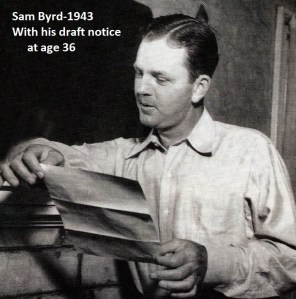 Byrd had been a former major league baseball outfielder for eight years and a backup to Babe Ruth with the New York Yankees. When Ruth was traded to the Boston Braves Byrd turned to golf. He was a teaching pro at Philadelphia Country Club for three years (1937-39) and at Merion Golf Club for four years (1940-43). In early 1943 Byrd received a letter from his Draft Board to report for a physical. He was 36 and would be 37 before the year was over. He was not drafted. Now he was the head professional at a club in Detroit.
 Trenham Golf History
Leave a comment