
“DID YOU KNOW”
The 1951 Ryder Cup took a day off for football!
The 1951 Ryder Cup was played on Pinehurst Country Club’s No. 2 course in early November. Earlier dates would have been better for the resort. It was “High Season” in Pinehurst. The 425-room Carolina Hotel had to turn away 600 potential reservations. While the Ryder Cup was being played, the other three golf courses would be open for guest play.
Each of the US and GB&I teams was composed of ten professionals. Non-playing captain Arthur Lacey and his selection team had the option to choose anyone for the GB&I team but went with the top eight from the British PGA “Order of Merit”. Those eight were announced on the last day of July. The News of the World newspaper assisted with the finances for the GB&I team, so the two finalists in its World Match Play tournament in late September were added to the team.
The US team was selected in early October through a system of points accrued on the PGA Tour over two years. Sam Snead led the points list by a large margin. Banged up from his automobile accident and playing a limited schedule, Ben Hogan was fifth on the list. By a vote of the PGA officers, Snead, a former member of the Philadelphia PGA, was named playing captain.
Richard Tufts, owner of the facility and a future president of the USGA, took golf and the Ryder Cup seriously. No. 2, the championship course of its four golf courses, was usually closed for the summer months. Now it was November, and no one had been allowed to play the course yet. To make the 7,007-yard golf course play as difficult as possible, Tufts, and Pinehurst’s golf professional Donald Ross had the fairway grass mowed at a higher height than usual. With cool, damp weather and heavy fairways, many of the par-four holes would be two full wood shots.
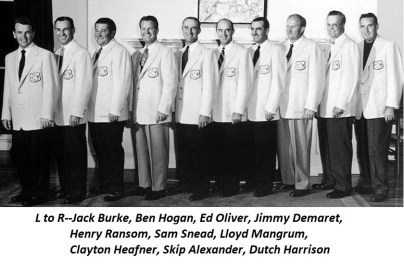 In the south, college football in early November came before golf, even an international golf match, so the Ryder Cup was scheduled for Friday and Sunday. On Friday the US team won 3 of the possible 4 points in the foursomes (alternate strokes) matches. On Saturday the golf professionals attended the University of North Carolina/University of Tennessee football game, as guests of UNC. Number one raked Tennessee won 27-0.
Another story was Stewart “Skip” Alexander, a member of the US team and a member of the 1949 team. He had been fifth in money earned on the 1949 PGA Tour, and was eighth in September 1950. After a fifth place finish at Kansas City in late September, Alexander was ready for a break and anxious to get home to his wife and young daughter in North Carolina. Alexander was offered a lift by three Civil Air Patrol officers on a flight to Louisville, which he accepted. Nearing Evansville, Indiana the airplane’s reserve fuel tank malfunctioned. The pilot tried to land the plane at the Evansville Airport, but crashed at the edge of the airfield. The plane was in flames. With his clothes on fire and a broken ankle, Alexander made it out of the plane just before the reserve gas tank exploded and the plane disintegrated, killing the three Civil Air Patrol officers.
With burns on his face, hands, and legs, along with an ankle broken in three places, and a broken arm, Alexander spent more than three months in an Evansville hospital. It took more than ten surgical procedures before he was well enough to leave in early January. As a Christmas present Wilson Sporting Goods renewed his contract as a PGA Tour staff member.
More surgeries were needed. In early February he checked into Duke University’s hospital, where he had graduated from college. More skin grafts were done and there was an operation on his hands. His fingers were stiff and pointing in different directions. The doctors broke his fingers and then shaped them into permanent curves for griping a golf club.
At the time of the airplane accident Alexander was in fifth place in Ryder Cup points and an assumed lock to make the 1951 team. But now late in 1951 he needed to earn some additional points. Later in the year Alexander returned to the PGA Tour to see what he could do. A tie for 20th at the Reading (PA) Open in mid September garnered some points. When the team was finalized, he was the 10th and last man by the small margin of 6 points.
On the first day of the Ryder Cup Alexander and Dutch Harrison, who was down with the flu, were held out by Captain Snead. Snead believed that anyone who made the team should play one session if they were able. When Snead asked Alexander if he could play, he said he had not walked 36 holes since the final day of the 1950 US Open at Merion, but he would like to play. Having won the 1941 North and South Amateur at Pinehurst, Alexander was familiar with the course.
Alexander drew John Panton, one of Britain’s best players. As it turned out Alexander didn’t have to walk 36 holes. At the break for lunch Alexander was five-up. After 27 holes Alexander was eight holes to the good. He lost the 10th hole when he took three putts and then won the next hole to close out the match 8&7. The US team won 9-1/2 points to 2-1/2 for GB&I.
Later that year the Philadelphia sports writers honored Alexander as the “Most Courageous Athlete” of 1951.
In January 1952 Alexander was back at Duke University for more surgeries, and in May he began what would be a 34-year career as the head professional at Lakewood Country Club in St. Petersburg, Florida.
 Trenham Golf History
Leave a comment